
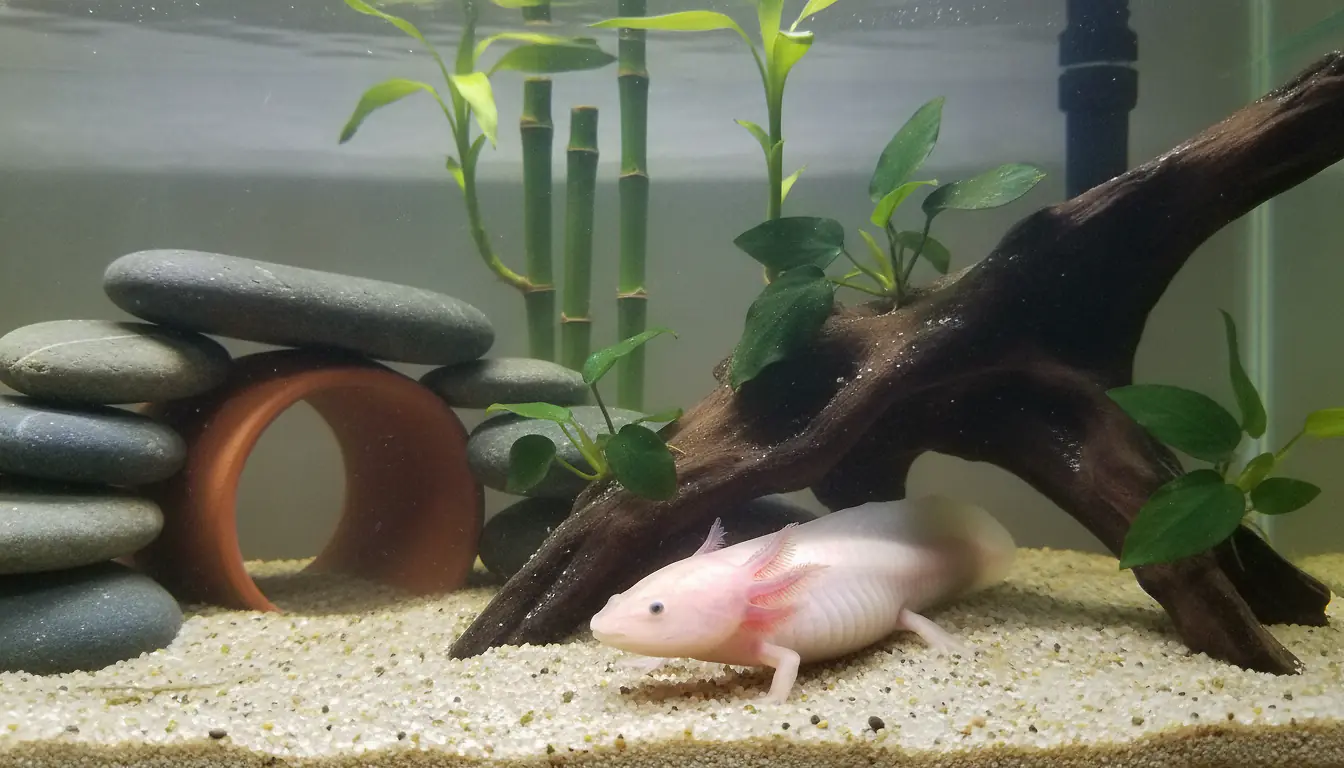
Decorating an axolotl tank is nothing like decorating a tropical fish tank. An axolotl has thin, scaleless skin, fragile external gills, no eyelids, and it sucks in anything that passes in front of its mouth. Every rock, root or hide therefore has to pass three tests: nothing it can swallow, nothing sharp, and nothing that changes the water. Here is how to choose bamboo, wood, rocks and hides, what is best banned, and how to prepare everything before filling the tank.
The three rules of safe axolotl decor
The axolotl feeds by suction: it opens its mouth wide and swallows whatever is in front of it, food but also gravel. A swallowed stone can cause an intestinal blockage. The Housing page on axolotl.org sets two simple thresholds: sand of 1 mm or less, which passes through harmlessly, or pebbles larger than the animal's head, impossible to swallow.
Second rule: no sharp edges. An adult axolotl measures 18 to 35 cm (7 to 14 in) and moves along the bottom and walls, brushing against them; a sharp rock or splintered wood cuts its skin, a classic entry point for fungal infections. Third rule: inert decor. Limestone, shells or metal change the water chemistry and move the tank away from the stable water parameters the animal depends on.
Bamboo, wood and rocks: which materials to choose
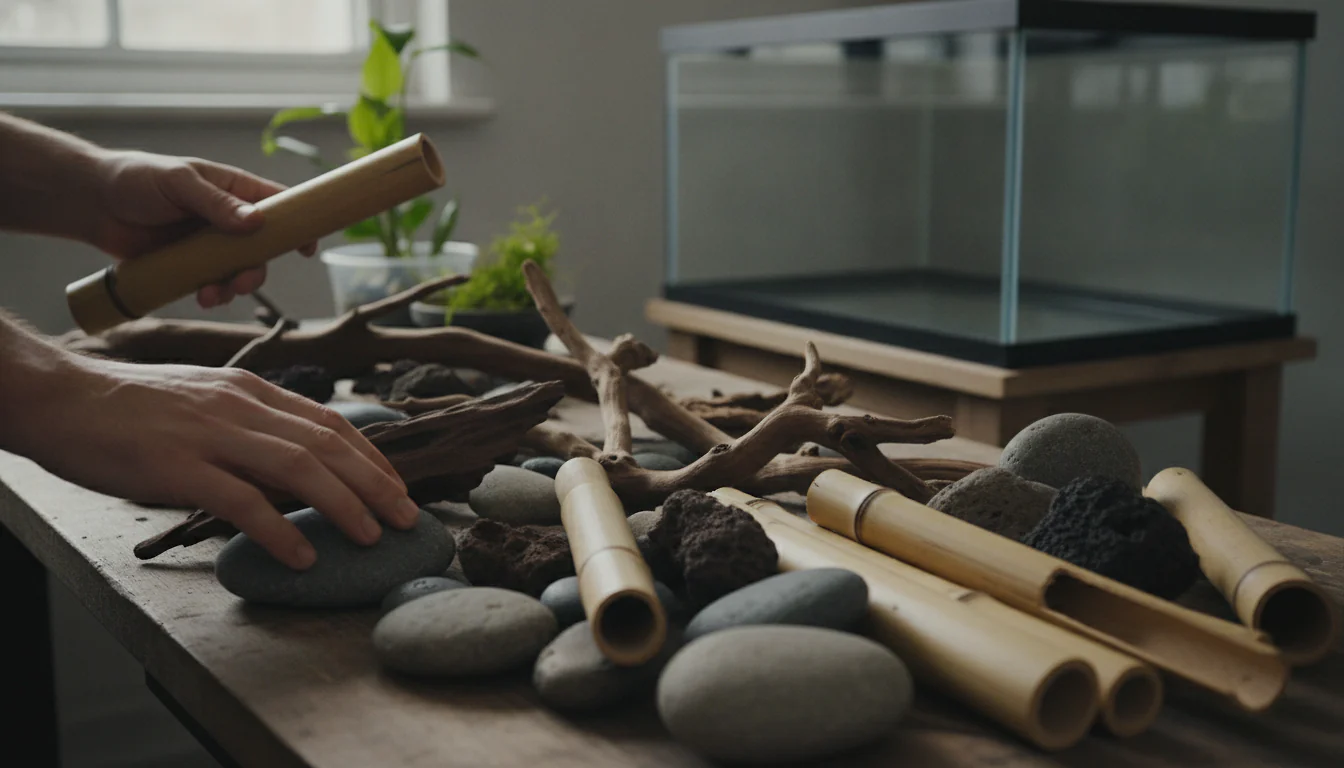
Underwater, some materials stay stable for years, while others rot, release tannins or harden the water. The table summarizes the benefit and risk of each option.
| Material | Benefit | Risk | Verdict |
|---|---|---|---|
| Lucky bamboo (Dracaena sanderiana) | Live plant, consumes nitrates | Rots if the leaves are submerged | Recommended, leaves out of the water |
| Dry bamboo stalk | Natural look, inexpensive | Decomposes, often varnished or treated | Avoid |
| Bogwood, mopani | Dense wood, sinks once waterlogged | Tannins that tint the water | Recommended after preparation |
| Collected wood, pine, cedar | Free | Resins, parasites, pesticides | Never use |
| Slate, granite, quartz | Inert, flat or rounded | Sharp edges if poorly chosen | Recommended |
| Limestone, marble, volcanic rock | Attractive | Hardens the water, abrasive surface | Never use |
Lucky bamboo (Dracaena sanderiana)
Benefit : Live plant, consumes nitrates
Risk : Rots if the leaves are submerged
Verdict : Recommended, leaves out of the water
Dry bamboo stalk
Benefit : Natural look, inexpensive
Risk : Decomposes, often varnished or treated
Verdict : Avoid
Bogwood, mopani
Benefit : Dense wood, sinks once waterlogged
Risk : Tannins that tint the water
Verdict : Recommended after preparation
Collected wood, pine, cedar
Benefit : Free
Risk : Resins, parasites, pesticides
Verdict : Never use
Slate, granite, quartz
Benefit : Inert, flat or rounded
Risk : Sharp edges if poorly chosen
Verdict : Recommended
Limestone, marble, volcanic rock
Benefit : Attractive
Risk : Hardens the water, abrasive surface
Verdict : Never use
Bamboo in an axolotl tank: live yes, dry no
The bamboo that is useful in an axolotl tank is actually a dracaena sold under the name lucky bamboo. Its roots dip into the water and absorb nitrates, while the stems and leaves stay above the surface, wedged into the lid or a support. A dry bamboo stalk, on the other hand, softens and molds over time: it is better kept for terrariums.
Wood in an axolotl tank: bogwood and mopani
Hardwoods sold in aquatic pet stores, such as bogwood, mopani or cholla, work well. They release tannins that turn the water amber and may lower the pH slightly, which is harmless but worth monitoring. Resinous woods and branches picked up in the forest remain off the list, since you can't know what they contain.
Rocks: favor slate and rounded pebbles
Stacked slate creates stable overhangs, and tumbled granite and quartz don't alter the water. Limestone rocks raise pH and hardness, far from the ideal range of 7.4 to 7.6 given by the Requirements page on axolotl.org. A few drops of white vinegar on a rock are enough to unmask it: if it fizzes, it contains limestone.
Axolotl hides: shape, number and placement
With no eyelids, the axolotl avoids direct light and spends much of the day sheltered. A tank without a hide exposes the animal to a source of chronic stress: gills folded forward, loss of appetite, restless swimming. Plan for at least one hide per axolotl, plus a spare, so that none is driven out by a tank mate.
A good hide has an entrance much larger than the body, no sharp rim, and enough room for the animal to turn around without rubbing its gills. Unglazed terracotta pots laid on their side, food-grade PVC half-pipes, resin caves designed for aquariums or slate arches glued with aquarium silicone all do the job. Floating plants and slow-growing plants such as anubias add more shade.
Narrow openings
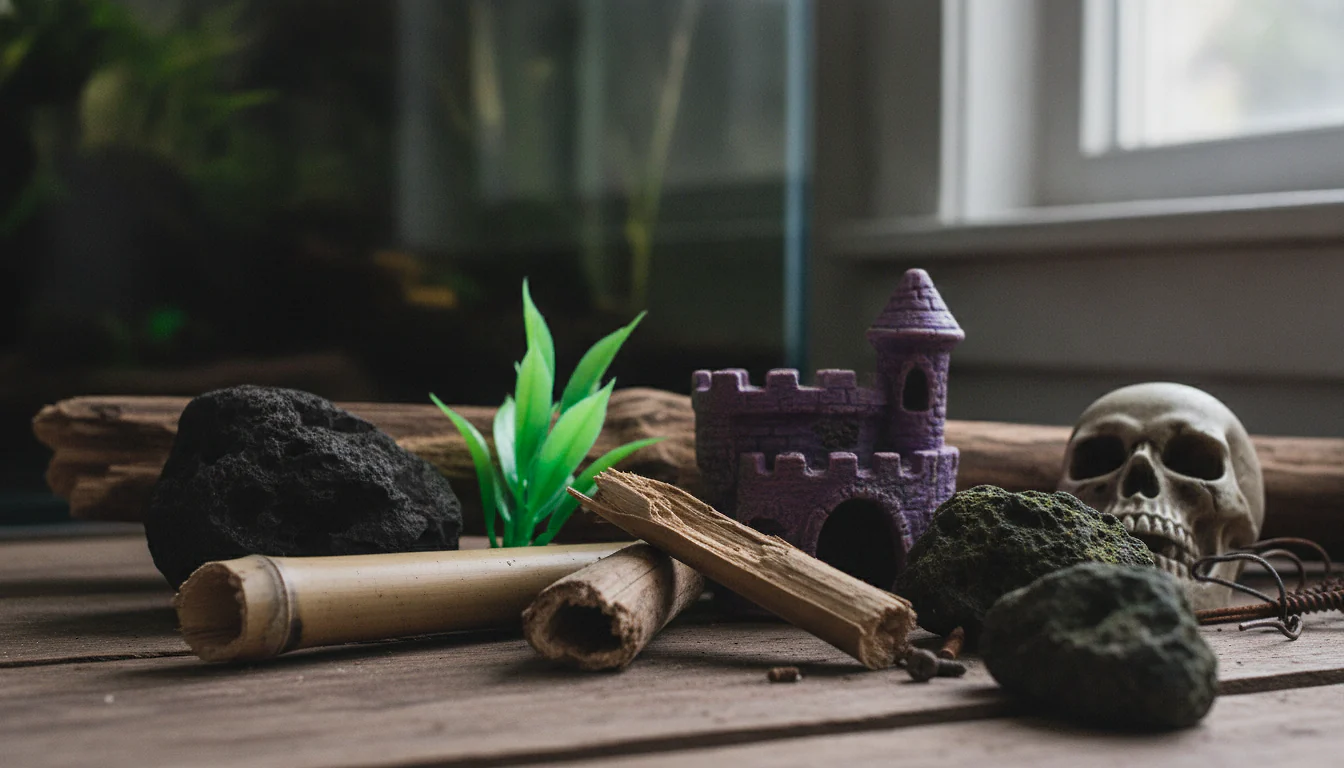
Decor with openings barely wider than the head, such as some resin skulls or castles, can trap an axolotl that squeezes into them. Choose generous openings or seal small holes with aquarium silicone.
Place the hides on the side opposite the filter outlet. For a 60 to 100 liter (16 to 26 gallon) tank, a flow of about 150 liters (40 gallons) per hour is enough, and the decor also helps break up the residual current. Temperature remains the main comfort criterion: the water should stay between 16 and 18 °C (61 to 64 °F) and never approach the 24 °C (75 °F) that stresses the animal, which is why shaded areas away from the light fixture are valuable.
Materials to avoid in the tank
Decor that suits fish isn't necessarily suitable for an amphibian that touches everything with its skin and mouth. Rule out:
The choice of substrate also shapes the decor: fine sand or a bare bottom prevents any gravel ingestion and lets you set heavy rocks directly on the glass.
Preparing and installing the decor before filling the tank
New decor that is poorly prepared can cloud or tint the water or introduce pollutants. Preparation is ideally done before cycling the tank, so that bacteria also colonize the surfaces of the rocks and wood.
Rinse each item in clean water, with no soap or detergent.
Scrub the rocks and do the vinegar test to rule out limestone.
Soak the wood in a bucket of water, changing the water until the wood sinks and the water stays only lightly tinted.
Run an old pair of tights over each piece: wherever the fabric snags, the axolotl's skin would be damaged. Sand the piece down or discard it.
Set the heavy rocks and hides on the bottom glass, then add the sand around them to prevent any collapse.
Leave a clear area at the front of the tank for feeding the animal: in a 45 cm (18 in) tank, two hides and one root are enough.
Keep exploring
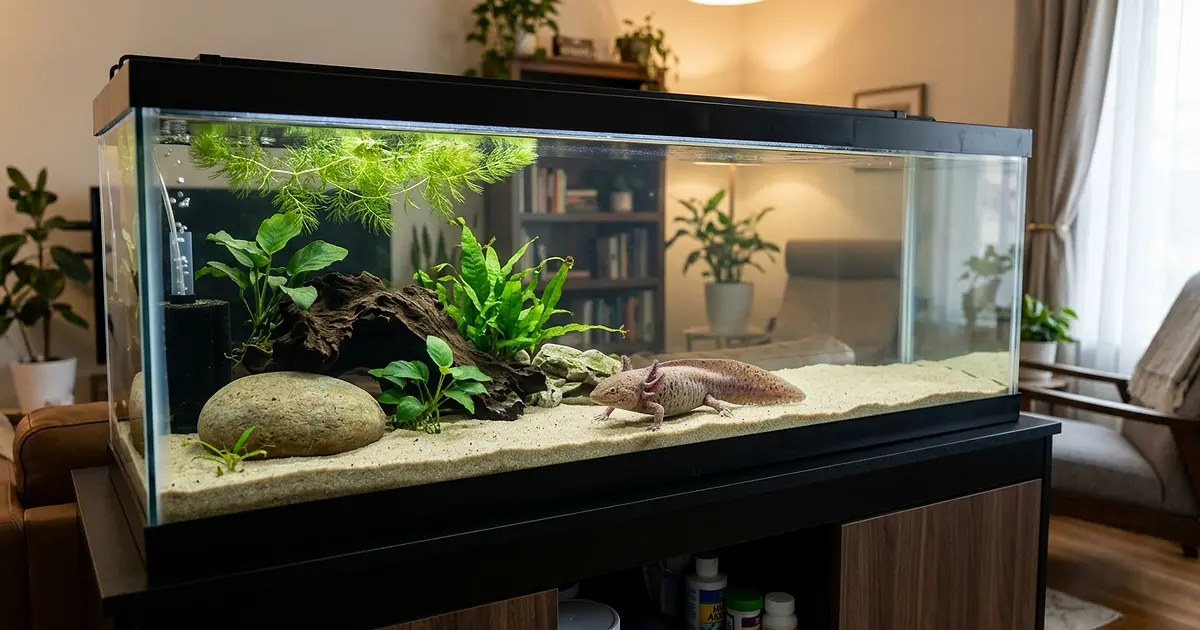
Set up the ideal axolotl tank: minimum size requirements, filtration options, safe substrates, compatible plants, lighting, and target water parameters.
Frequently Asked Questions
Does an axolotl need a hiding place?
Can you put wood in an axolotl tank?
Is bamboo dangerous for an axolotl?
Related Articles
What Size Tank Does an Axolotl Need?
Minimum tank size for axolotls is 20 gallons (75L) for one. Learn the ideal dimensions, why bigger is better, and how to choose the right tank.
Read more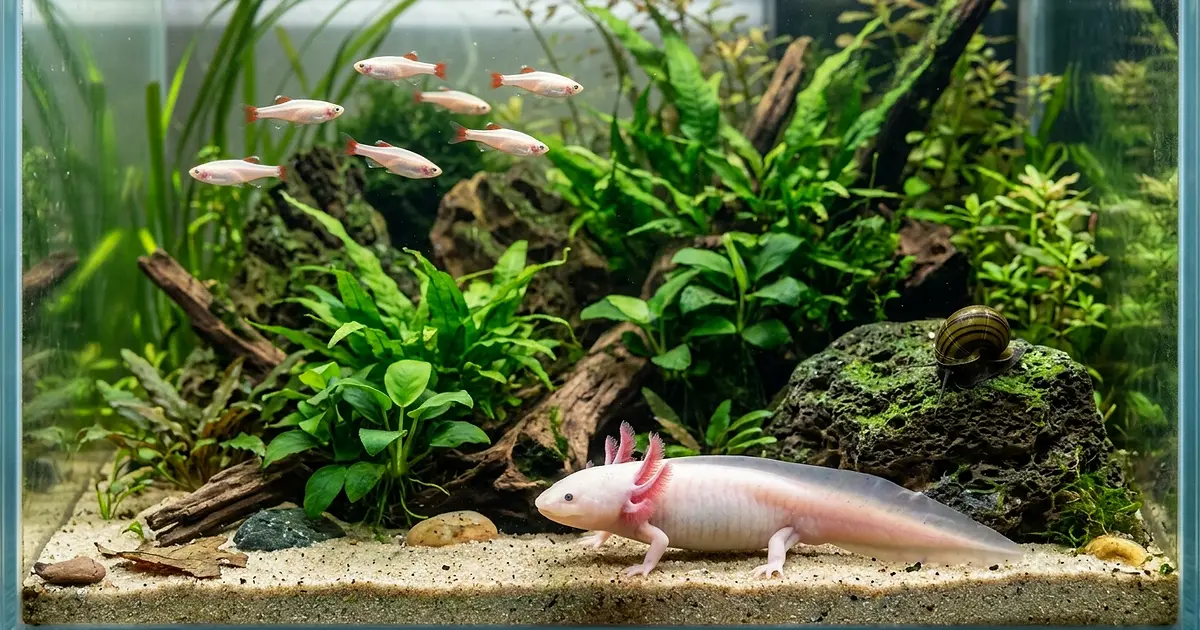
Axolotl Tank Mates: What Can Live With Axolotls?
Can axolotls live with fish? Learn which tank mates are safe, which to avoid, and why most axolotls are best kept with their own kind.
Read more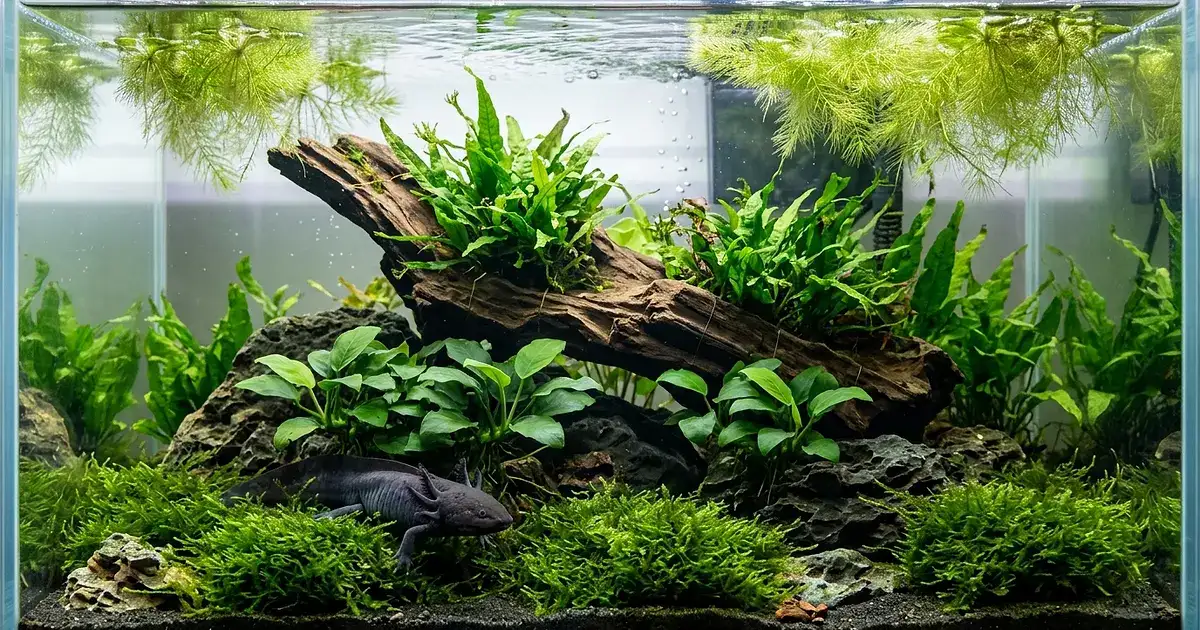
Best Plants for Axolotl Tanks
Top aquatic plants safe for axolotl tanks: java fern, anubias, java moss, and more. Low-light, axolotl-proof plants that improve water quality.
Read more