Axolotls are full of surprises. Here are 50 facts that showcase just how extraordinary these aquatic salamanders are.
Biology & Anatomy
- Axolotls are amphibians, not fish, despite living entirely underwater
- They belong to the mole salamander family (Ambystomatidae)
- Their genome contains 32 billion base pairs, making it 10 times larger than the human genome
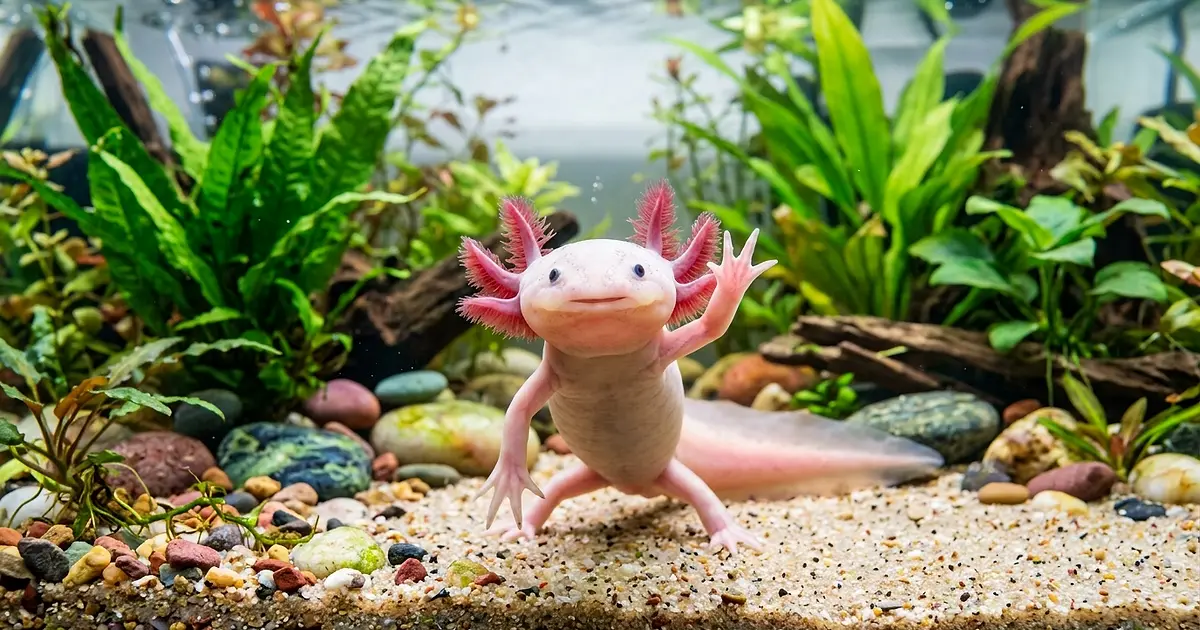
- Axolotls have three pairs of external gills that they can move independently
- They have both gills and lungs, but their lungs are underdeveloped
- Axolotls have no eyelids and are sensitive to bright light
- Their tiny teeth are designed for gripping, not chewing, they swallow food whole
- Adults typically reach 15-30 cm (6-12 inches) in length
- They have four fingers on their front legs and five toes on their back legs
- Axolotls can detect electrical fields in the water using special sensors
Regeneration
- Axolotls can regrow entire limbs including bones, muscles, nerves, and blood vessels
- They can regenerate parts of their brain and spinal cord
- A damaged heart regenerates without scarring
- They can regrow their gills if bitten off by a tank mate
- The regrown body parts are perfect copies, not scar tissue
- Regeneration takes approximately 40-60 days for a full limb
- Young axolotls regenerate faster than older ones
- Scientists have observed axolotls regenerate the same limb multiple times
- During regeneration, mature cells dedifferentiate back into stem-like cells
- Despite massive cell division during regeneration, axolotls rarely develop cancer
Origin & History
- The name “axolotl” comes from Nahuatl (Aztec language) and means “water monster”
- They are named after Xolotl, the Aztec god of fire, lightning, and death
- Axolotls are native to Lake Xochimilco in Mexico City
- They originally also lived in Lake Chalco, which was drained in the 1970s
- Axolotls have been used in scientific research since the 1860s
- The first axolotls arrived in Europe in 1864, sent to the Jardin des Plantes in Paris
- The axolotl appears on the Mexican 50-peso bill
- In Aztec cuisine, axolotls were considered a delicacy
Conservation
- Axolotls are classified as Critically Endangered by the IUCN
- The wild population has declined by over 99% since the 1990s
- There may be fewer than 1,000 axolotls left in the wild
- The main threats are urbanization, pollution, and invasive fish species
- Invasive tilapia and carp eat axolotl eggs and compete for food
- Despite being nearly extinct in the wild, millions exist in captivity worldwide
- Mexico has established breeding programs to preserve genetic diversity
Pet Keeping
- Axolotls live 10-15 years in captivity with proper care
- They need cool water between 16-20°C (60-68°F)
- A single axolotl needs a minimum 75-liter (20-gallon) tank
- Earthworms are the best staple food for adult axolotls
- Axolotls should not be handled because their skin is fragile
- They are crepuscular, most active at dusk and dawn
- Axolotls can learn to recognize their owners and may swim to the glass during feeding time
- Females can lay 100-1,000 eggs per breeding event
- Baby axolotls may cannibalize siblings if not separated by size
Colors & Morphs
- There are over 20 recognized color morphs of axolotls
- The leucistic (pink/white with dark eyes) is the most popular pet morph
- GFP axolotls glow green under ultraviolet light due to a jellyfish gene
- True blue axolotls do not exist in nature, blue photos show GFP under UV light
- Wild type axolotls are dark brown-green with gold speckles
- Chimera axolotls, split down the middle with two different colors, are among the rarest
Keep Reading
Related Articles
What Is an Axolotl? Facts, Origin & Why They're Special
The axolotl (Ambystoma mexicanum) is a fully aquatic neotenic salamander from Mexico. Species classification, anatomy, cultural significance, and basic facts.
Read more
How Long Do Axolotls Live? Lifespan Guide
Axolotl lifespan in captivity averages 10-15 years. Learn what affects their longevity and how to maximize your axolotl's life expectancy.
Read more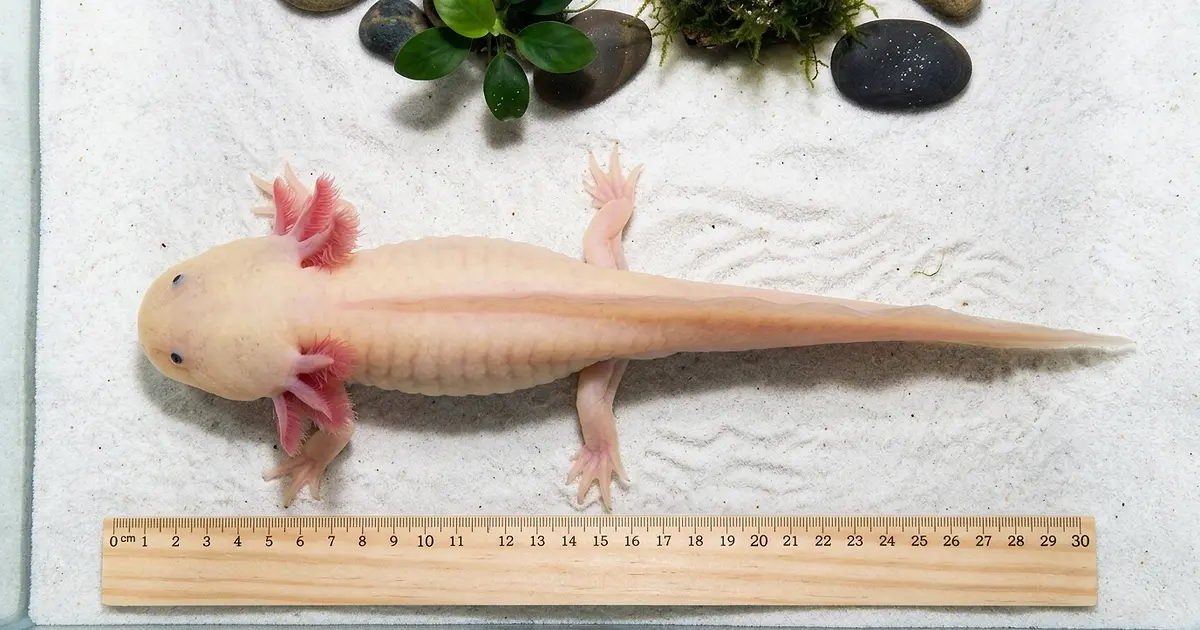
How Big Do Axolotls Get? Size & Growth Chart
Axolotls grow to 15-30 cm (6-12 inches) as adults. Complete growth chart from baby to adult with factors that affect size.
Read more